


Definition Bollinger bands. Developed by John Bollinger, bollinger bands are lines rendered at fixed intervals around a moving average, as a function of a market Syntax Formula 1. Where: AM = arithmetic mean. D1 = raw deviation. D2 = squared deviation. TSD = total squared deviation. MSD = mean squared deviation. SD = standard deviation. P = number of periods. DP = data point. Parameters SERIES Examples BB()

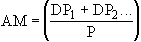
2. 
3. 
4. 
5. 
6. 
or
Required if the formula name declares the SERIES parameter.
INPUT
Required if the formula name declares the INPUT parameter.
<ma_len>
Moving average length.
<std_dev>
Standard deviation.
<env_length>
Envelope length.
<shift>
A number, positive or negative, enclosed in brackets defining the number of bars (periods) to shift the formula line. Typically used only in formulas that will be rendered in chart windows.
BB_EX2(INPUT,ma_len=9,std_dev=1,env_len=2)=BB(INPUT,ma_len,std_dev,env_len)[1]See also: Bollinger Bands Study